Impact

What changes when a school gets debate.

Reach is the first measure: more than twenty partner schools, roughly 40,000 students across them, and free competitions, coaching, and resources across the Charlotte metro. The measures that matter come after that.

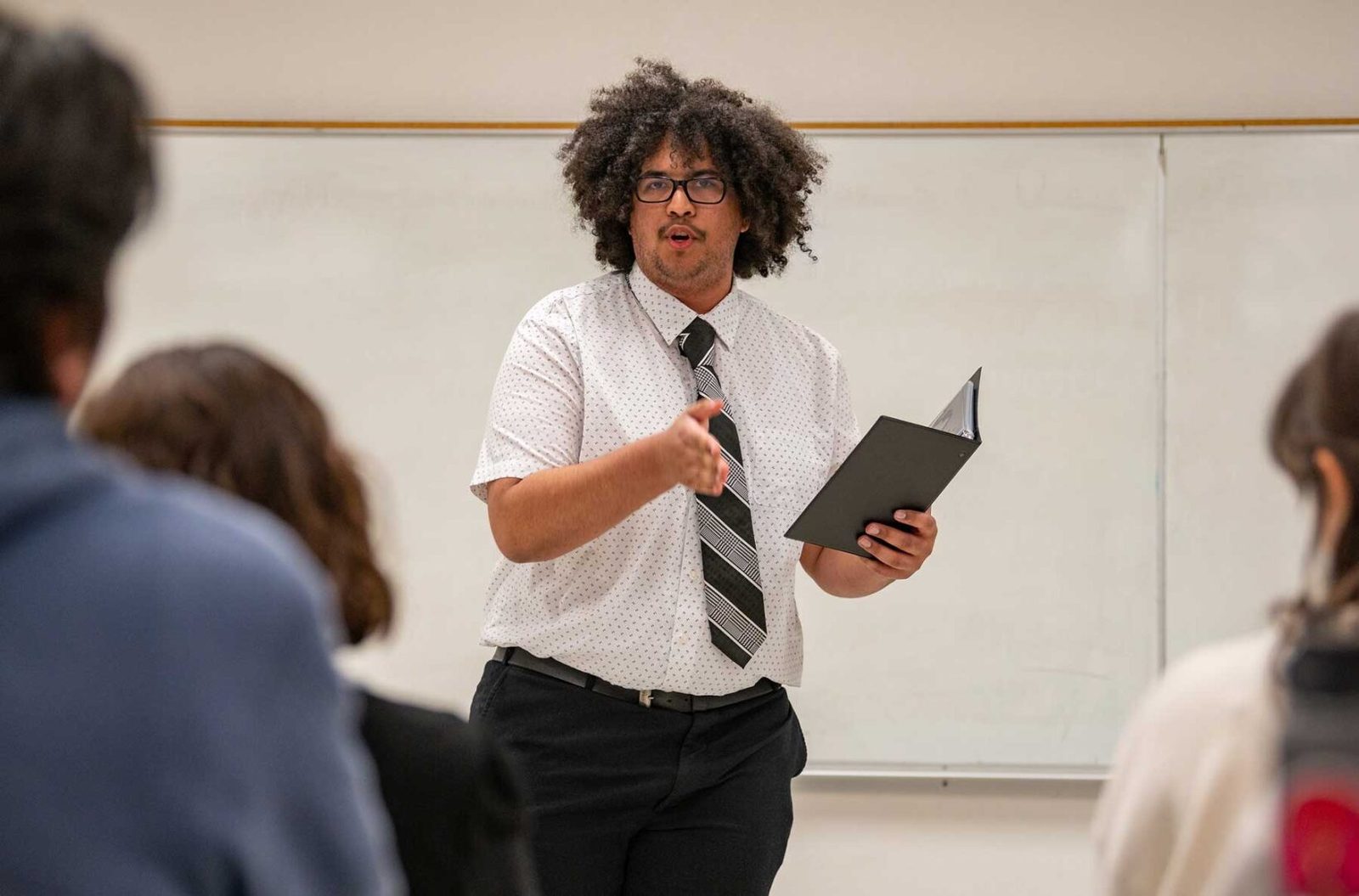
A student delivering a speech from a binder in front of a class
20+partner schools across the Charlotte area
~40,000students enrolled across the schools we partner with
3years bringing speech and debate to Charlotte classrooms
Freecoaching, competition support, and resources for every partner school

Figures as of September 2026, from CUDL program records. Enrollment is the combined enrollment of partner schools, not the number of active debaters.

Where the work happens

CUDL serves Title I schools across Charlotte-Mecklenburg and the broader Charlotte metro area, backed by corporate and philanthropic partners.

Charlotte metro reach

More than twenty partner schools across Charlotte-Mecklenburg and the surrounding metro, with combined enrollment of roughly 40,000 students.

Competitions and workshops

Locally organized and supported tournaments, preparation workshops, and a pathway toward regional and state-level competition.

Free academic resources

Topic analysis, case-writing guides, and strategy briefs for Lincoln-Douglas and Public Forum, free to any student or coach.

In-person coaching

Coaches who come to the school, during and after the school day, and train teachers alongside students.

Sustainable programs

Curriculum and support that let a teacher without a debate background keep a program running year after year.

Corporate and philanthropic partnership

Supporters and sponsors include Ally Bank, Wells Fargo, Bank of America, and Alight Solutions, and CUDL received an Economic Opportunity Grant.

Impact beyond participation

A tournament entry is easy to count. These are the things debate builds that a headcount misses.

Confidence

Standing up, speaking, and being taken seriously, for many students for the first time.

Communication

Explaining a complex idea to a stranger in four minutes, clearly enough to win a ballot.

Research

Finding credible sources, reading them closely, and knowing what they do and do not prove.

Evidence-based reasoning

Building a claim from warrants and data instead of from opinion.

Collaboration

Preparing with a partner and a team, and coaching younger students the next year.

Critical thinking

Anticipating the strongest objection to your own position and answering it.

Public speaking

Delivery, pacing, and composure, practiced every week in front of an audience.

Academic engagement

Students who debate read more, write more, and show up more.

College readiness

Skills, mentors, and a record of achievement that carry into applications and classrooms.

Where the work is

Charlotte-Mecklenburg Schools has 103 Title I schools for 2026-27, most of them in the crescent of neighborhoods west, north, and east of uptown. CUDL's partner schools are concentrated there.

See the communities map What we have built

Charlotte's rank among the 50 largest U.S. metros for upward mobility Lower is better. Sources: Chetty et al. (2014); Opportunity Insights (2024) as reported by WFAE and Axios.
Charlotte's rank among the 50 largest U.S. metros for upward mobility2014 study (children born about 1980)50th of 502024 update (children born 1992)38th of 50
Charlotte's rank among the 50 largest U.S. metros for upward mobility
2014 study (children born about 1980)50th of 50
2024 update (children born 1992)38th of 50

Why speech and debate matters

The strongest evidence comes from studies of urban debate leagues that serve students much like ours. Here is what they found, stated as carefully as the researchers stated it.

Selected findings from peer-reviewed studies of urban debate leagues Each bar is scaled to its own study's measure; read the labels, not the bar lengths across rows. Full citations on the research page.
Selected findings from peer-reviewed studies of urban debate leaguesChicago, 2009: graduation, African American male debaters70% more likely to graduateChicago, 2009: dropout3x less likely to drop outHouston, 2021: cumulative GPA+0.66 grade pointsHouston, 2021: SAT math+52 pointsHouston, 2021: SAT reading and writing+57 pointsBoston, 2023: ELA test scores+0.13 SD (about 68% of a year)
Selected findings from peer-reviewed studies of urban debate leagues
Chicago, 2009: graduation, African American male debaters70% more likely to graduate
Chicago, 2009: dropout3x less likely to drop out
Houston, 2021: cumulative GPA+0.66 grade points
Houston, 2021: SAT math+52 points
Houston, 2021: SAT reading and writing+57 points
Boston, 2023: ELA test scores+0.13 SD (about 68% of a year)

Boston: reading gains and college-going

A 2023 study of Boston Public Schools students who joined the Boston Debate League found that debate participation raised English language arts test scores by 0.13 standard deviations, equivalent to about 68 percent of a full year of average ninth-grade learning. Gains were concentrated in analytical skills rather than rote ones, with no harm to math, attendance, or discipline, and the study found positive effects on high school graduation and postsecondary enrollment. Impacts were largest for students who were lowest achieving before they joined.

Schueler, B. E., and Larned, K. E. (2023). Interscholastic policy debate promotes critical thinking and college-going: Evidence from Boston Public Schools. Educational Evaluation and Policy Analysis. doi.org/10.3102/01623737231200234

Chicago: graduation and college readiness

Studies of the Chicago Debate League, using Chicago Public Schools records from 1997 to 2007, found that students who debated were more likely to graduate from high school, more likely to meet ACT college-readiness benchmarks in English and reading, and gained more in GPA over high school than comparable peers, after accounting for prior achievement and self-selection into the activity. Among African American male students, debaters were 70 percent more likely to graduate and three times less likely to drop out. The graduation association held for students at the highest risk of not finishing.

Mezuk, B. (2009). Urban debate and high school educational outcomes for African American males: The case of the Chicago Debate League. Journal of Negro Education, 78(3), 290–304. eric.ed.gov/?id=EJ878481. Mezuk, B., Bondarenko, I., Smith, S., and Tucker, E. (2011). Impact of participating in a policy debate program on academic achievement: Evidence from the Chicago Urban Debate League. Educational Research and Reviews, 6(9), 622–635. Anderson, S., and Mezuk, B. (2012). Participating in a policy debate program and academic achievement among at-risk adolescents in an urban public school district: 1997–2007. Journal of Adolescence, 35(5), 1225–1235. sciencedirect.com

Chicago: college enrollment

A 2019 study followed 6,411 Chicago Public Schools graduates from 1997 to 2007, about a quarter of whom debated in the Chicago Debate League. Debaters were more likely to enroll in college than comparison students, and more likely to enroll in four-year rather than two-year institutions, after adjusting for eighth-grade test scores, neighborhood poverty, and demographics.

Shackelford, D. T., Ratliff, S., and Mezuk, B. (2019). Participating in a high school debate program and college matriculation and completion: Evidence from the Chicago Debate League. Educational Research and Reviews, 14(11), 397–409. academicjournals.org

Houston: grades and SAT scores

The largest study to date linked debate participation and academic records for 35,788 Houston Independent School District students from 2012 to 2015, including 1,145 debaters. After propensity-score matching on prior achievement and demographics, debaters had cumulative GPAs 0.66 points higher and scored 52 points higher on SAT math and 57 points higher on SAT evidence-based reading and writing than comparable non-debaters.

Ko, T. M., and Mezuk, B. (2021). Debate participation and academic achievement among high school students in the Houston Independent School District: 2012–2015. Educational Research and Reviews, 16(6), 219–225. eric.ed.gov/?id=EJ1302954

Baltimore: middle school engagement

A ten-year study of Baltimore City students found that middle school participation in the Baltimore Urban Debate League was associated with higher standardized test scores, a lower likelihood of chronic absenteeism, and a higher likelihood of attending a selective-entrance high school. It was the first quantitative study of debate at the elementary and middle school level.

Shackelford, D. (2019). The BUDL effect: Examining academic achievement and engagement outcomes of preadolescent Baltimore Urban Debate League participants. Educational Researcher, 48(3). doi.org/10.3102/0013189X19830998
How to read this evidence

These studies examine policy debate in urban debate leagues, not Lincoln-Douglas or Public Forum specifically, and most use matching or fixed-effects designs rather than random assignment. The skills they measure, close reading of dense sources, argument construction from evidence, and speaking under pressure, are the same skills Lincoln-Douglas and Public Forum develop. We cite the findings as strong evidence that debate access matters, not as a guarantee of any particular outcome for any particular student. The U.S. Department of Justice's CrimeSolutions evidence registry rates the urban debate league model "Promising" for its effects on high school graduation and college readiness.

Full bibliography with methods, samples, and links   Last reviewed September 13, 2026

Why this matters in Charlotte

In 2014, Harvard economist Raj Chetty and colleagues ranked the 50 largest U.S. metro areas by the chance that a child born into a low-income family would rise up the income ladder. Charlotte ranked 50th. The finding reshaped the city's civic agenda and led to the creation of Leading on Opportunity in 2017.

The 2024 update from Opportunity Insights, which tracked children born in 1992, showed Charlotte had climbed to 38th, with the third-largest improvement among the 50 metros. That is real progress and an unfinished job. College completion remains one of the most reliable routes to higher adult earnings, and debate is one of the few school activities with evidence that it moves students toward it.

Sources: Chetty, R., Hendren, N., Kline, P., and Saez, E. (2014). Where is the land of opportunity? The geography of intergenerational mobility in the United States. Quarterly Journal of Economics. Chetty, R., et al. (2024). Changing opportunity: Sociological mechanisms underlying growing class gaps and shrinking race gaps in economic mobility. Opportunity Insights. Coverage of the Charlotte ranking: WFAE and Axios Charlotte.

The chain we are building

  1. Access to debate

    Coaching, materials, and competition entry at no cost, in schools that would otherwise have none.

  2. Stronger academic and communication skills

    Studies of urban debate leagues link participation to gains in reading, analysis, and argumentation.

  3. College readiness

    Chicago debaters were more likely to meet ACT college-readiness benchmarks in English and reading.

  4. Higher-education outcomes

    Boston and Chicago debaters were more likely to graduate high school and enroll in college, particularly four-year institutions.

  5. Long-term economic mobility

    Postsecondary completion is one of the strongest predictors of adult earnings, in a city that ranked last among large U.S. metros for upward mobility in 2014.

Findings summarized from eight peer-reviewed studies of urban debate leagues in Chicago, Baltimore, Houston, and Boston, and from Opportunity Insights research on Charlotte. Read the full research bibliography.

Invest in the outcome.

Every partner school, every tournament entry, and every workshop is funded by supporters who want Charlotte's students to have this. Join them.